


5000+ UPSC Selections | 1200+ IAS / IPS Officers
For Counselling Call – 8800222298
Do You want us to call? Fill the Form
The UPSC CSE Mains is a candidate’s most crucial stage on the road to becoming a civil servant. Unlike the Preliminary stage of the assessment, comprising objective-type questions, this phase is descriptive and considers how well the candidate understands the issues, processes analytic thinking, and writes a clear exposition of ideas. It is composed of nine papers, among which are an Essay, four General Studies papers, two Optional papers, and two qualifying papers (English and some regional language). Because the syllabus is so vast, one must start concentrating on subject-wise important topics for the UPSC CSE Mains while preparing.
1. Essay Paper: UPSC CSE Mains
The Essay Paper, offering no prescribed curriculum, typically has topics that may broadly be divided into two categories—philosophical or abstract, and current socio-political.
Important Topics: UPSC CSE Mains
Ethics and morality in public life
Education, technology, and empowerment of the youth
Role of women and gender equality issues
Democracy and governance
Environmental issues and sustainable development
Tip: Work on the structure for your essays, with introduction, body, and conclusion. Quotes, examples, and case studies should form the basis of your content.
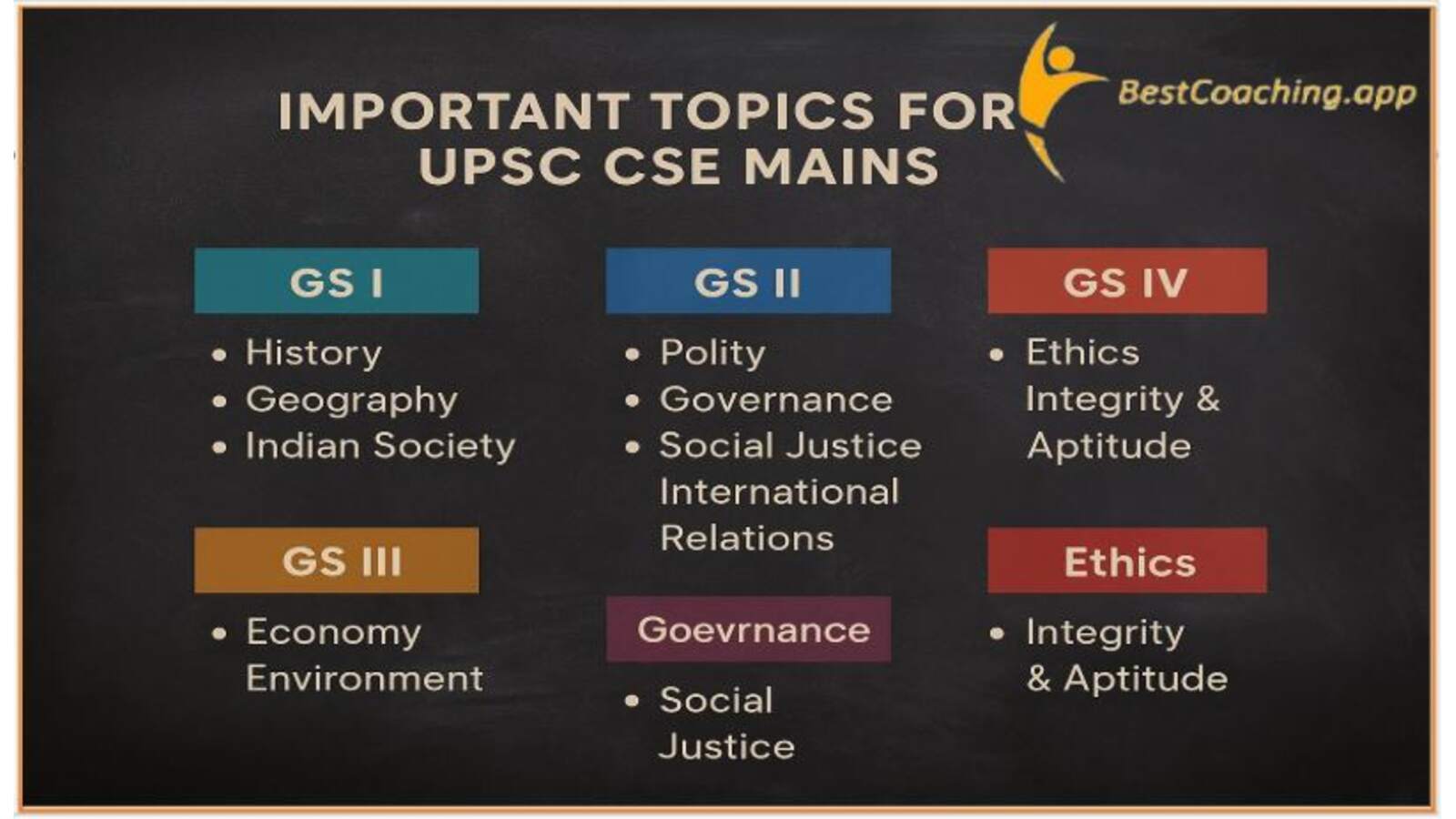
2. UPSC CSE Mains General Studies Paper I: Indian Heritage, History, and Society
This paper checks knowledge of culture, history, and social issues.
Important Topics: UPSC CSE Mains
Indian art forms, architecture, and literature
Ancient Indian history
Medieval Indian history
Modern Indian history – Freedom struggle, important personalities
Post-independence consolidation
Indian society – caste, diversity, impacts of globalization, position of women
Effect of globalization on Indian culture
UPSC CSE Mains General features of Indian society
General Studies Paper I: Heritage, History, and Society
GS Paper I is concerned with India’s cultural heritage, history, and society. It comprises ancient and medieval history, freedom struggle, post-Independence consolidation, and salient features of Indian society.
One must understand the contributions of ancient civilizations, temple architecture, classical art forms, and the religious movements of Bhakti and Sufi. Modern history majorly focuses on the national movement, the role of social reformers, and the making of the Indian Constitution.
General Studies Paper II: Governance and International Relations
The second paper focuses on governance, the Constitution, polity, and international relations of India. The subjects of constitutional provisions, structure of Parliament, separation of powers, and judicial review should be well understood apart from governance issues like e-governance, transparency, citizen charters, and civil services.
Social justice areas, such as welfare schemes for vulnerable sections, the rights-based approach, education, and health-related policies, are being regularly asked for.
4. General Studies Paper III: Economy, Environment, Science, and Security
The paper is dynamic and includes current events with applied knowledge.
Important Topics:
Indian economy, growth, budget, banking, and inclusive development
Infrastructure-energy, roads, ports, airports
Agriculture reforms, MSP, APMC, allied sectors
Science and Technology-AI, robotics, space, health tech
Environment-climate change, conservation, pollution, and treaties (Paris Agreement, etc.)
Disaster management-NDMA guidelines, and recent disasters
Internal security-cyber security, terrorism, border management
General Studies Paper IV: Ethics, Integrity, and Aptitude
The test is to check the candidate’s moral and ethical judgment. It includes such topics as ethics in public administration, integrity, accountability, emotional intelligence, and the role of civil servants in society. The paper also features case studies that challenge candidates to apply ethical reasoning to real-life circumstances.
Theoretical as well as practical knowledge should be developed for concepts such as honesty, compassion, and probity. Kantian, Gandhian, and Rawlsian ethics are often used as reference points.
Optional Subject Papers: A Deep Dive into Some Specialization
The optional subject carries significant importance in being able to determine one’s final rank in UPSC CSE Mains. A candidate chooses the optional subject according to interest, their academic background, or its scoring trends. Normally chosen popular optional subjects are Political Science & International Relations (PSIR), Geography, Sociology, Anthropology, and History.
In PSIR, core subjects are political ideologies, Indian political thought, comparative politics, and India’s foreign policy; while in Geography, it is climatology, geomorphology, Indian Physical Geography, and Human Geography. Sociology mainly covers thinkers, institutions, caste and class, gender relations, and change in Indian society.
The Role of Plutus IAS in Mains Preparation
Structured preparation under expert guidance definitely adds some honor to grooming for UPSC CSE Mains. Plutus IAS, with its well-researched study material, personalized mentoring, and answer-writing sessions, remains one of the most reliable choices of coaching.
As per the latest trends, the curriculum of Plutus IAS includes:
Regular mains test series with detailed evaluation
Essay and Ethics enrichment sessions
Answer writing workshops for paper-wise preparation
Mentoring for optional subjects by well-versed faculty.
Contact details
Phone no:8448440231
Website: https://plutusias.com/
Conclusion
Preparing for UPSC CSE Mains calls for a methodical approach, keeping in focus the requirements of the individual subjects. While creating and applying ethical reasoning, understanding the socio-political scenario of India, and tackling the economic and environmental scenario are all challenging, each one needs commitment and inquisitive analysis.
Related Articles
Best IAS Coaching in Hyderabad