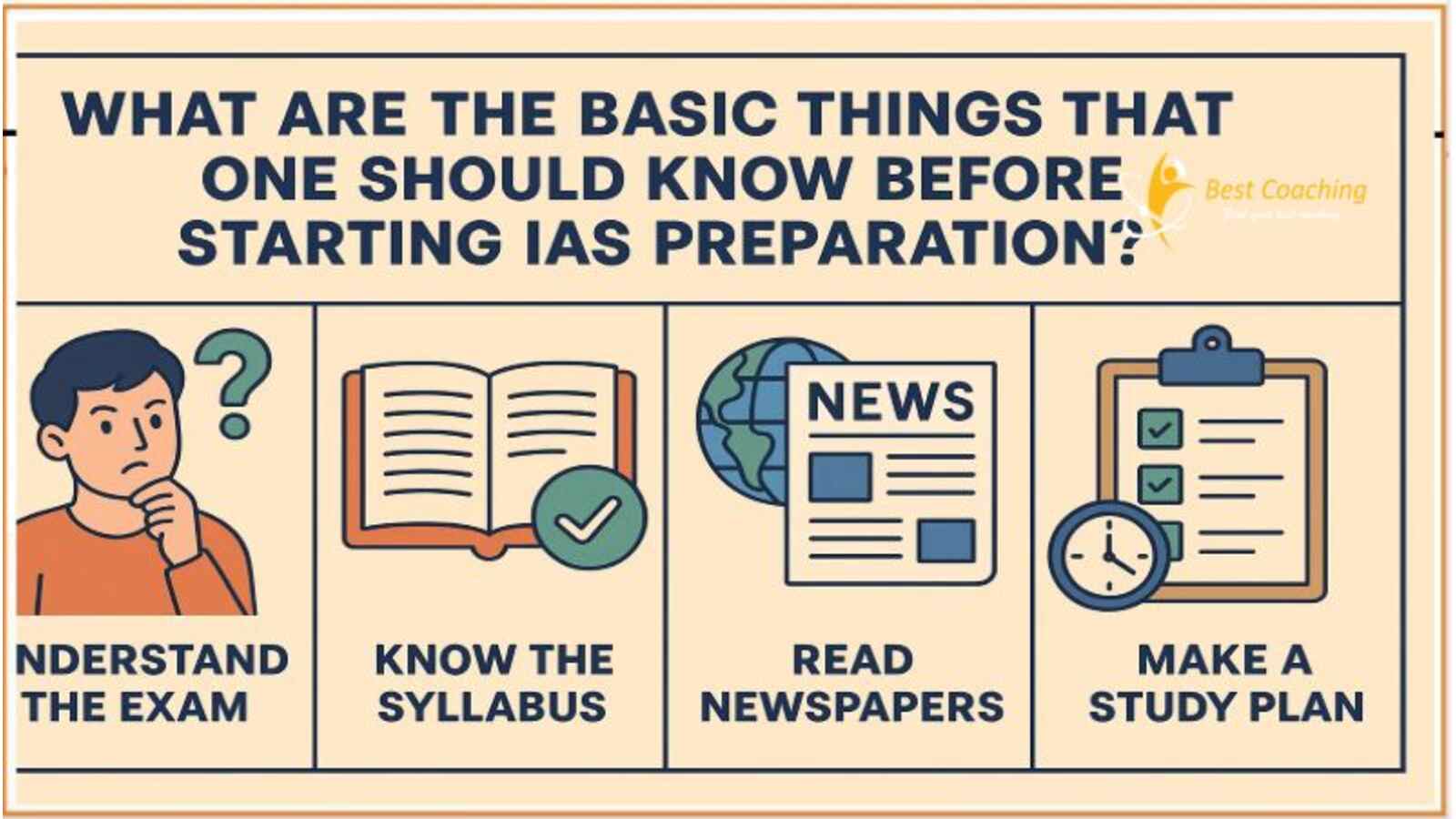



Perhaps one of the most honored and difficult tests in India is the UPSC Civil Services Examination (CSE), more commonly shrunk to the IAS examination. Thousands of aspirants dream of becoming IAS, IPS, or IFS officers, but very few manage to get through. Before starting preparation, one must focus on understanding certain bare requirements, mentality, and strategy for a successful attempt. This is a comprehensive guide on what a beginner must know before preparing for the IAS. In this article, we will explore the Basic Things That One Should Know Before Starting IAS Preparation.
1. Get Acquainted with the Exam Structure || IAS Preparation
The UPSC Civil Services Examination is conducted in three stages:
a. Preliminary Examination (Prelims)
- Objective in nature
- Two papers: General Studies (GS) and CSAT (Civil Services Aptitude Test)
- It is a screening test that is not considered while drawing up the final merit list
b. Main Examination (Mains)
- Descriptive in nature
- Nine papers in total (Essay, four GS papers, two Optional papers, and two qualifying papers)
- These marks are counted towards the final ranking.
c. Personality Test (Interview)
- Conducted by the members of the UPSC Board
- Assesses the personality traits of the candidate, awareness, decision-making, etc.
- Knowing the structure will actually help test candidates in preparing accordingly-whether they want to focus on factual or analytical aspects.
2. Familiarizing Yourself with the Syllabus || IAS Preparation
One of the first steps in the UPSC Series Preparation would be going through the syllabus. It is large but is not random. It is clearly classified for Prelims and Mains.
- Prelims GS: History, Geography, Polity, Economy, Environment, Science & Technology, and Current Affairs.
- CSAT: Logical reasoning, comprehension, and basic numeracy.
- Mains: GS, Essay-writing, and Optional Subject-working under topics of a much deeper nature.
- Download an official UPSC syllabus and keep it with you for frequent reference.
03. Eligibility Criteria
Before going to a competitive exam, check if you are eligible for it:
Age Limit: Generally 21 to 32 years; slightly relaxed for reserved categories.
Educational Qualification: Graduation from any stream.
Attempt Limit: It depends upon the category (General – 6, OBC – 9, SC/ST – unlimited till age limit).
04. Selection of Optional Subject || IAS Preparation
Maxing nearly 500 marks in the Mains exam, the Optional Subject really can change the tide. The following are some brief considerations in the choice of an optional subject:
- Background or interest in academics
- The availability of good materials and guides
- Trends in scoring (subjective though)
- Success ratio and past choices of successful UPSC toppers
The more common optional subjects are Political Science and International Relations (PSIR), Sociology, Anthropology, Geography, and History.
5. Make a Study Plan
There must be a well-defined path set for UPSC preparation. Come up with a plan that works:
- Set short-term and long-term goals
- Time management for subjects
- Set a time for revision and mock tests
- Modify accordingly from time to time, depending on weaknesses and strengths
Beginning early, at least a year, gives ample time for preparation and revision.
6. Strengthen Basics Through NCERTs || IAS Preparation
- NCERT books for classes 6 to 12 form the backbone of UPSC preparation. They provide an explanation with clarity and cover the basics.
Start with:
- History: Classes 6 to 12
- Geography: Classes 6 to 12
- Polity: Classes 9 to 12
- Economics: Classes 9 to 12
- Science: Classes 6 to 10 (Prelims)
These need to be done first before moving to some next-level books such as Laxmikant (Polity), Spectrum (History), etc.
7. Being Current with Current Affairs Is Essential || IAS Preparation
UPSC is famously said to test a candidate’s knowledge about the ongoing national and international affairs. Current affairs hold immense importance, especially for prelims and GS mains.
- Some important sources include-
- Shed The Hindu or Indian Express daily
- PIB (Press Information Bureau)
- Monthly magazines like Vision IAS, or Insights on India
- Yearbooks like India Yearbook, Economic Survey
Make notes, especially of issue-based ones that can be linked to the syllabus.
8. Joining a Good Coaching Institute (Optional but Beneficial) || IAS Preparation
Many are able to successfully achieve their goals without the assistance of coaching; however, coaching helps give structure to one’s study, along with the huge benefit of being mentored through one’s personal growth journey and peer learning.
- With offerings like:
- Experienced Faculty
- Latest Study Material
- Personalized Mentorship
Online Mode, which works for a working professional… Plutus IAS gained popularity!
Conclusion:
This is all about What Are the Basic Things That One Should Know Before Starting IAS Preparation? Studying hard is not sufficient to crack the IAS; one has to study smart. A candidate must understand the pattern of the examination and the syllabus. Get your basics right through the NCERTs, keep up to date with current affairs, and enhance writing skills. Prepare with utmost clarity for self-study, or else join an institute such as Plutus IAS for consistency.
Related Articles
Best IAS Coaching in Delhi