


5000+ UPSC Selections | 1200+ IAS / IPS Officers
For Counselling Call – 8800222298
Do You want us to call? Fill the Form
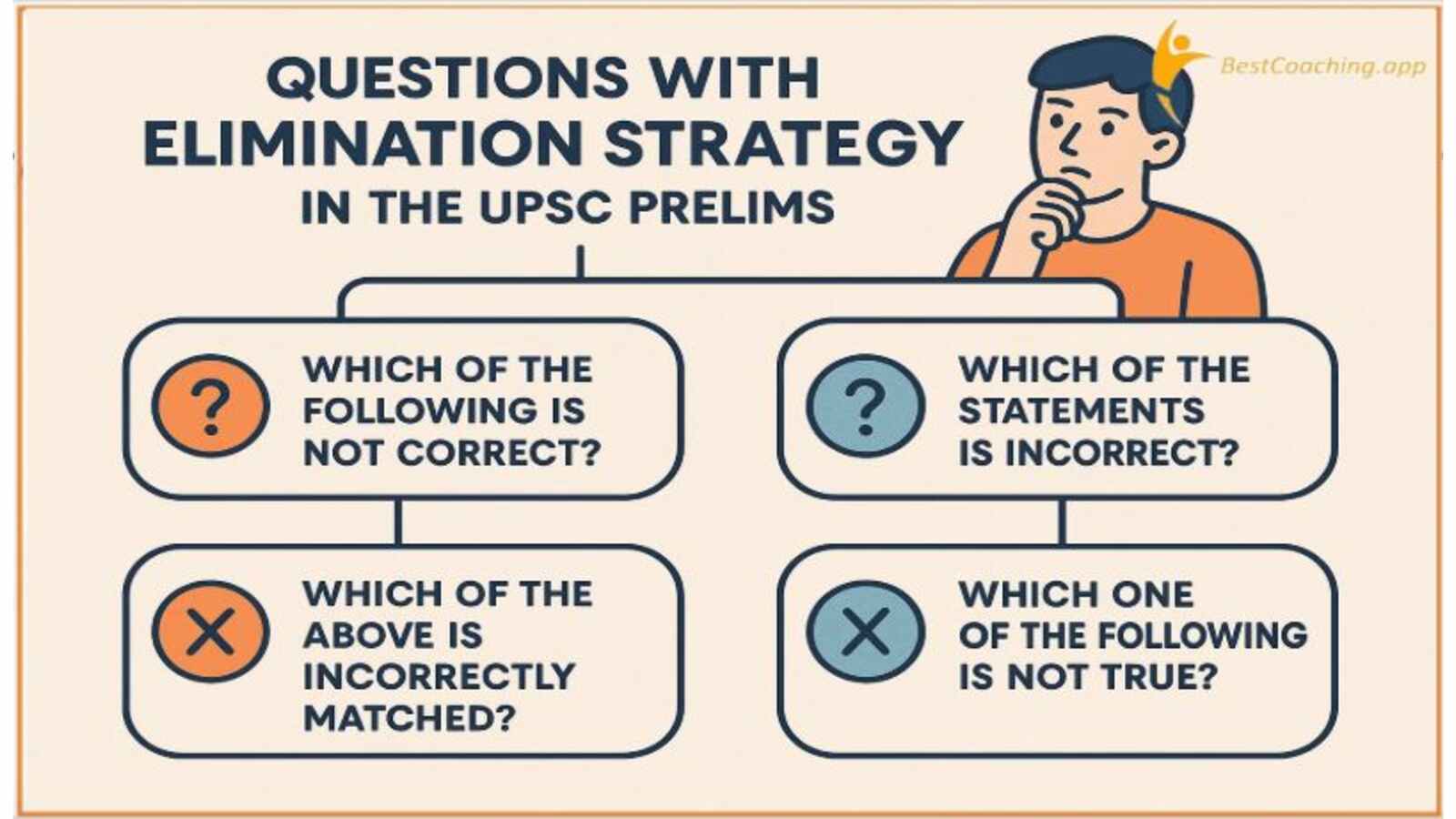
Known for its unpredictable nature and tough questions, coupled with negative marking, the UPSC Civil Services Preliminary Examination exercises unpredictability. A few thousand aspirants get shortlisted to the next phase from lakhs who appear for the prelims every year. In such a competitive exam, it’s not only about how much you know, but also about how smartly you manage the questions you are unsure of. This is where the art of elimination comes to your rescue in the UPSC Prelims. In this article, we will get to know about What are some questions with the elimination strategy in the UPSC Prelims.
Prelims Elimination Strategy in UPSC
This strategy analyzes each option of a multiple-choice question and eliminates those that are incorrect. By doing so, one can reduce the number of probable answers and make it easier to choose between them, sometimes even enabling one to arrive at a fair guess or an outright answer without knowing the answer fully.
Works best in items where:
One option confuses or relates too closely to another.
Extreme or absolute terms occur, such as only, never, and always.
Conceptual clarity is what’s tested rather than factual recall.
Example-Based Application of the Elimination Strategy
Question 1:
Which of the following statements are correct about the Fundamental Duties in the Indian Constitution?
They are enforceable by law.
The 44th Amendment Act added them.
They apply to both citizens and foreigners.
They promote a sense of nationalism.
Elimination Strategy:
Statement 1: Not enforceable by law; a known fact. So, eliminate any option that contains 1.
Statement 2: A right introduced by the 42nd, and not the 44th, Amendment. Eliminate any option that contains 2.
Statement 3: They apply only to citizens and not foreigners. Eliminate any option that contains 3.
Only Statement 4 seems right. So, answer (c) 4 only is correct.
Elimination Strategy:
Narmada – Amarkantak: Surely, the Narmada is correctly placed.
Godavari originates from the Triambak Hills (near Nasik, but not exactly the Nasik Hills): ambiguous – to be kept for now.
Cauvery-Brahmagiri: correct.
Option (d) looks quite probable, but if you are unsure about 2, you can follow a safer bet by agreeing to (c) if you are confident about 2 and 3 being correct.
This is where intelligent elimination helps you take calculated risks.
Common Patterns That Help in Elimination
1. Absolute Statements are Often Incorrect
Statements using “always,” “never,” or “only” are generally false in UPSC questions because most concepts have exceptions.
2. Too Broad or Too Narrow
If an option generalizes too much or is overly restrictive, there’s a high chance it’s wrong.
3. Mismatch between Option and Question Theme
Sometimes, options are technically true but irrelevant to the question. Analyzing such options can allow a student to cross them out.
4. Odd-One-Out Approach
If among the four options, one appears to be entirely off-topic or odd, it is most probably incorrect. Eliminating such options becomes to your benefit.
Benefits of the Elimination Strategy in the UPSC Prelims
It minimizes negative marking by avoiding blind guesswork.
Increases a candidate’s confidence in tougher, ambiguous questions.
Saves a lot of time during the writing of the paper, wherein candidates may overthink the question.
Increases precision, especially in areas of Polity, Environment, or Economy, where options look almost equally plausible.
Learning the Strategy with Plutus IAS
In trying to fully master the elimination strategy in the UPSC Prelims, there needs to be consistent practice, mentoring, and mock test analysis. Institutes like Plutus IAS do put this strategy into practice. Further, their prelims test series, class discussions/ case studies, along with mentorship, analyze preparation not just the syllabus, but from the point of view of developing aptitude to tackle uncertain questions per se with logic.
Plutus IAS is characterized by:
- Test Series of Superior Quality and Real Exam Difficulty
- In-depth Case Studies and Answer/explanation for Conceptualization of Elimination Technique
- Faculty Expertise: Sharing the Strategy of Question Solving
- Regular Practice Sessions on Decision Making and Smart Guessing
For beginners or veterans, once you begin applying elimination, your prelims journey is technically transformed by Plutus IAS through proven expertise.
Conclusion
The UPSC Prelims truly tests intelligence, apart from knowledge. One has to not only study but also apply strategies such as elimination, wherever the mere knowledge of a person fails. With perseverance and proper teaching from institutes like Plutus IAS, mastering the elimination strategy in the UPSC Prelims is achievable, and the IAS dream gets a little closer.
Related Articles
Best IAS Coaching in Hyderabad