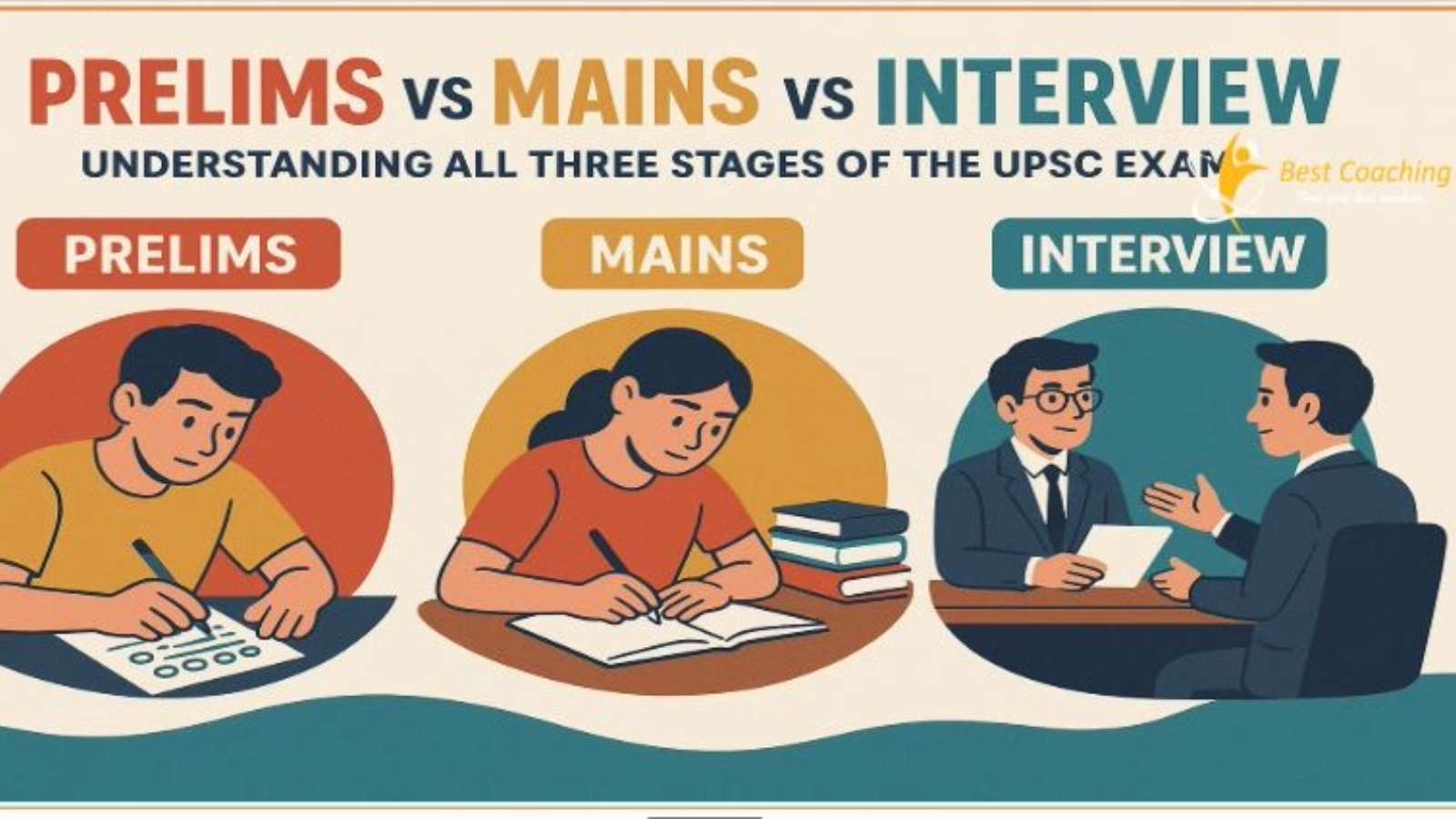



The UPSC Civil Service Examination is one of India’s toughest and most prestigious exams, serving as a gateway to top administrative roles like IAS, IPS, and IFS. In this article, we will discuss Prelims vs Mains vs Interview: Understanding All Three Stages of the UPSC Exam.
Stage 1: The Preliminary Examination- Test Your Range and Speed
The Preliminary Examination is the very first hurdle in the UPSC journey. Hence, being an objective-type exam, its function is to screen out those candidates whom the Commission considers non-serious. One cannot really get into the merit list based on marks scored in the Preliminary Examination; cracking Prelims is a must to step into the next stage.
Structure and Pattern
The Preliminary Examination consists of two papers:
Paper I: General Studies (GS-I)
Paper II: Civil Services Aptitude Test or CSAT (General Studies Paper II officially)
GS-I covers Indian history, geography, polity, economy, environment, and current affairs. CSAT is a qualifying paper that mainly tests comprehension, logical reasoning, data interpretation, and basic mathematics. However, one has to secure 33 percent marks in CSAT to qualify, whereas only the marks of GS-I actually decide who has cleared Prelims.
Nature of Questions and Approach: Prelims vs Mains vs Interview
The question in Prelims is objective and factual, demanding good conceptual clarity and wider reading. Accuracy and elimination techniques are of great importance, given that there is negative marking (? marks will be deducted for every wrong answer).
The biggest challenge here is that the cut-offs vary every year based on the level of difficulty and competition, making Prelims a test of both breadth and accuracy. It is often said, “Prelims are more about elimination than selection,” capturing the extremely competitive nature of this stage.
Stage 2: The Main Examination—Test of Your Depth and Expression
Reaching this far means clearing Prelims and stepping into the UPSC Mains, often regarded as the core of the Civil Services Examination. Mains are descriptive, unlike Prelims, which are objective. They test the grasp of the subject and how well one can articulate and express it clearly within the given time.
Syllabus and Analytical Depth: Prelims vs Mains vs Interview
The Mains syllabus is very extensive and interdisciplinary in nature. The General Studies papers cover topics from Indian traditions to Governance, International Relations, Ethics, and Case Studies. One is expected to not just know the facts but to be able to analyze, critically evaluate, and give a balanced opinion.
And also, the Essay and Ethics papers require creative thinking and value-based reasoning. Writing speed, answer structure, and ability to connect topics are important here.
Optional papers allow you to prove your skills in a specific discipline. The choice of options based on one’s interest and background can indeed become a deciding factor in the candidate’s ultimate marks.
About Answer Writing
Passing Prelims may require only grasping the syllabus, but clearly articulating Restructuring-the-answers is demanded in Mains. Aspirants spend months honing their answer-writing skills, focusing on how they structure answers- introduction, body, and conclusion; the richness of content; and managing time during the exam.
Stage 3: The Interview- Testing Your Personality and Presence of Mind
The last stage of the UPSC examination process is the Personality Test or, more commonly, the Interview. The purpose of the interview is not to check academic knowledge but to ascertain the integrity, judgment, leadership qualities, and suitability of one to enter into public service.
What Happens in the Interview Room?
A panel of senior officers, academicians, and subject experts at the UPSC Office in New Delhi conducts the interview, which lasts 25-40 minutes and carries 275 marks.
The board checks your confidence, clarity of thought, honesty, social awareness, and ability to withstand pressure. Questions are mostly based on your Detailed Application Form (DAF), current affairs, situations contemplating values and ethics, your hobbies, and general matters of national and international importance.
Subjective Yet Most Important
Unlike the first two stages, the Interview is that highly subjective. So, two candidates having similar knowledge can have widely different marks based on their presentation. Therefore, mock interviews, personality development, and self-awareness are given due importance in the last leg of preparation.
The final rank in the merit list is calculated based on Mains (1750 marks) and Interviews (275 marks), i.e., out of 2025. A good interview score can help in a big way for service allocation. Plutus IAS is the best coaching for upsc preparation for prelims, mains, and interviews.
Conclusion:
This is all about Prelims vs Mains vs Interview: Understanding All Three Stages of the UPSC Exam. The UPSC Civil Services Examination is not just about cracking an exam; it serves as a life-changing journey for candidates. Each stage is designed to filter people who are not just intellectually capable but are also emotionally and ethically balanced.
Related article