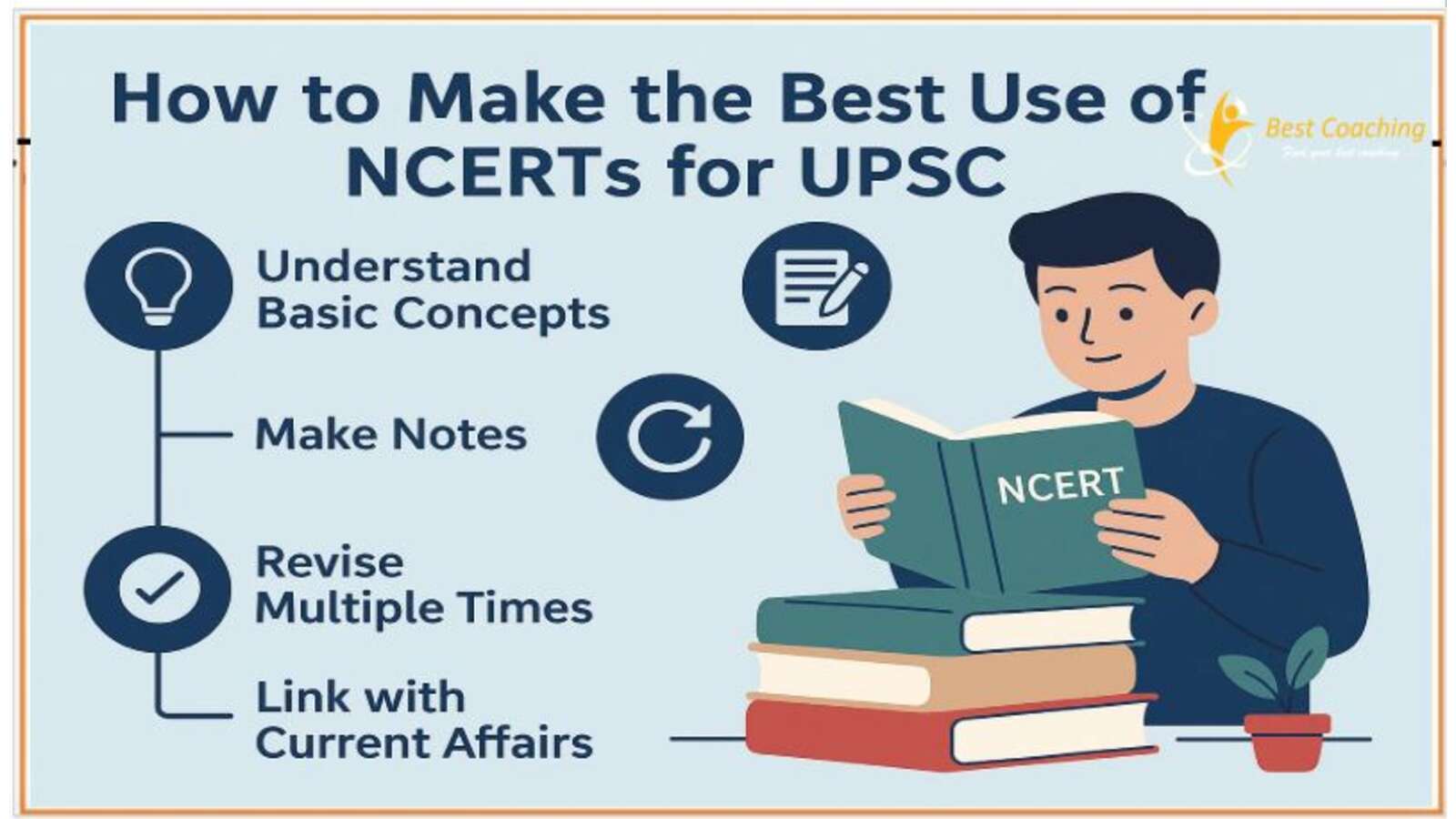



Considered among the most difficult examinations in India, the UPSC Civil Services Examination has a huge syllabus along with tough competition, and so choosing study materials is a very critical decision. Of numerous study materials available, NCERT books have stood tall as the most authentic, trustworthy, and foundational resource that can assist an aspirant in UPSC preparation. This article will act as a complete guide on how NCERTs can be best utilized in strengthening UPSC preparation. In this article, we will discuss how to make the Best Use of NCERTs for UPSC.
Why Should One Rely On NCERT for UPSC Preparation?
1. Authentic and Reliable Sources
NCERT books are published by the government of India and, over the years, have been known to be free from any kind of factual misrepresentation and biases in content.
2. Build Foundation
It is meant to be for building basic concepts for whichever subject an aspirant chooses. Most of the toppers of UPSC recommend NCERT for setting a firm foundation.
3. Easy to Understand
The language is straightforward, which makes it easy for aspirants belonging to different academic backgrounds.
4. NCERT-Based Questions in Prelims and Mains
Several questions come directly or indirectly from the NCERT Books in both Prelims and Mains.
5. Useful From Prelims From Mains
NCERTs can be useful not only for Preliminary but also for Mains (GS paper as well as Essay) and even in the Interview.
Importance of NCERTs for UPSC
1. Authentic and Reliable Source
NCERT books, published by the government of India, are known for their utmost factual accuracy and unbiased content.
2. Foundation Builder
The NCERT books have been made to build the base of concepts and thus are best for any beginner’s steps. Most UPSC toppers recommend the NCERTs for strengthening their foundation.
3. Easy to Understand
NCERT books use simple language and straightforward explanations, so people from diverse academic orientations can comprehend them.
4. Direct Questions in Prelims and Mains
A good majority of questions in Prelims and Mains are directly or indirectly derived from the NCERTs.
5. Helpful for Multiple Stages
NCERTs would help you for Prelims as well as for Mains (GS papers and Essay), while even at the Interview.
Procedure to Read NCERTs
1. Read in Chronological Order
Begin from the lower classes-(Class VI) and go up to Class XII. This logically builds your concepts.
2. Identify Important Chapters
Only some chapters in any book would be important. Use the UPSC syllabus and previous years’ papers to sieve out the high-yield topics.
3. Make Short Notes
While reading, jot down crisp notes. Write down definitions, important facts, and concepts in your own language.
4. Highlight Key Points
Highlight key points and facts. That would make it easier for you to revise.
5. Use NCERT Summaries
Many coaching institutes and websites offer NCERT summaries. Use these only after you have read the actual books.
6. Revise Regularly
Regular revision is important for retention. Follow a monthly revision plan.
Are NCERTs for Prelims?
1. Direct Questions
The UPSC Prelims has several factual questions that come directly from NCERTs- like geography maps, definitions, etc.
2. Conceptual Clarity:
To qualify for the prelims, one needs to understand fundamental concepts of economics, polity, and science.
3. Exercise of Objective Type
Once a book has been finished, one should try to assess one’s understanding by solving objective questions.
NCERTs for Mains
1. Building Arguments
Keeps the writer balanced to be able to write high-quality answers in the Mains.
2. Essay Paper
Providing facts, concepts, and examples from the NCERTs can complement their essay content.
3. GS Papers
Geographical, political, economic, and social concepts are directly applicable to GS Papers 1, 2, and 3
Integrating NCERTs with Other Resources
1. Link with Standard Books
Treat NCERTs as a core base and build upon them with standard books for particular subjects, such as Laxmikanth for Polity, Spectrum for Modern History, etc.
2. SCRATCH (use-based approach)
Consult the NCERTs whenever higher-level books make your concepts unclear.
3. Combine with Current Events
Combine the NCERT theory with current events. For example, linking NCERT Geography with natural disasters occurring in the news.
Note-Making Strategy from NCERTs
1. Choose Digitally or Manually
Keep it simple; do it the way you feel comfortable. The bulk of the aspirants use digital notes so as to edit multiple times.
2. Maintain Structure
Keep to a definite pattern- Headings, Subheadings, Bullet Points, and Diagrams wherever they are applicable.
3. Keep Revising and Updating
Keep your notes updated, taking into consideration current affairs and new developments.
Common Mistakes to Never Make
Reading without a Plan: Always follow a chronological approach.
Skipping the NCERTs: Never skip NCERTs, thinking, “This is too basic.”
Over-Highlighting: Be selective with highlighting; too much makes revision harder.
Never Revise: Periodic revision is the only way to cement your knowledge.
Conclusion:
This is all about how to make the Best Use of NCERTs for UPSC For UPSC aspirants, NCERTs are a wealth of resources. A well-planned reading schedule coupled with an effective note-taking strategy and the use of other resources for integration can bestow a boost on your preparation. Conceptual clarity is what the NCERTs provide, and that conceptual clarity is the very foundation upon which success in the UPSC Civil Services Examination rests. Though they are called school texts, think of them as indispensable UPSC tools, and you will see a smoother and more effective journey through preparation.
Related Articles