


5000+ UPSC Selections | 1200+ IAS / IPS Officers
For Counselling Call – 8800222298
Do You want us to call? Fill the Form
For several aspirants, CSAT in UPSC Prelims has gained too much importance while being the qualifying paper. It means if we do not clear the CSAT paper, our marks in the GS Paper I will not be counted. The last few years have seen the hardening of CSAT difficulty level such that even a well-prepared candidate finds it difficult to make 66 marks (33%). Are you thinking of how to improve your score in CSAT to be sure of clearing this paper with confidence? This guide shall look at this paper and the right approach, and hence, the most practical ways to do it.
Understanding the Nature of CSAT in UPSC Prelims
CSAT is an acronym for Civil Services Aptitude Test, which is General Studies Paper II at the preliminary UPSC Civil Services Examination. It further includes:
- Comprehension
- Interpersonal skills, including communication
- Logical reasoning and analytical ability
- Decision-making and problem-solving
- General mental ability
- Basic numeracy (up to Class X level)
It comprises a total of eighty questions for two hundred marks. A candidate must obtain a minimum of thirty-three percent, i.e., sixty-six marks, to declare an individual as qualified.
Why CSAT is Tricky Despite Being Qualifying
Unexpected Difficulty: Many aspirants focus primarily on GS Paper I and ignore CSAT. Then lately, the UPSC has made CSAT rather difficult in specific areas, especially comprehension and logical reasoning.
Basic Math and Reasoning Struggles: Even candidates from non-science backgrounds or those with weak mathematical backgrounds find this exam very taxing.
Negative Marking: 1/3rd marks of each question shall be deducted for every incorrect answer. It is a dangerous game to try your luck.
Hence, a strategic approach is essential to clear CSAT in the UPSC Prelims.
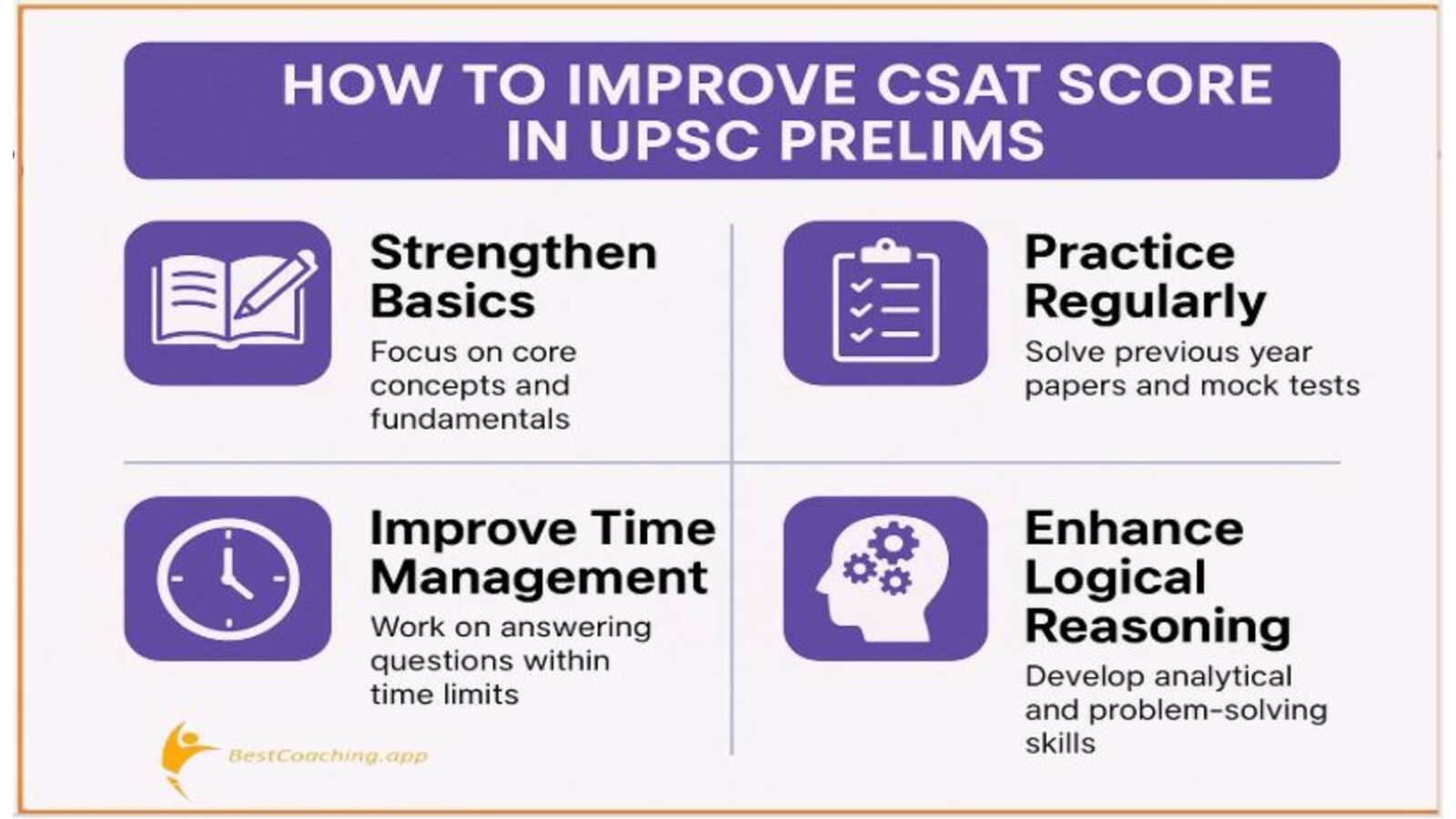
1. Know Your Strengths and Weaknesses
Before designing any kind of preparation plan, one should sit for a diagnostic test to analyse which topics are creating a hindrance in the candidate’s preparation: comprehension, numeracy, or reasoning. What if:
If one spends too much time on passages, then they should work on reading speed and summarization.
If maths is his weak subject, then he should work on Class 6–10 NCERT topics and speed math.
2. Build Conceptual Clarity
You do not need difficult application areas of maths or logic. However, you should have a clear concept at least on the basic areas.
Topics that need serious attention for CSAT are basically:
- – Percentages, Ratios, Averages
- – Time & Work, Time & Distance
- – Venn Diagram
- – Syllogism and Logical Reasoning
- – Reading Comprehension
- – Data Interpretation
Make full use of books like RS Aggarwal for Quantitative Aptitude and Arun Sharma for Logical Reasoning for practicing.
3. Timed Practice
The main thing in the test is managing time. You are given only 2.5 minutes per question. Regular practice with a timer aids inculcating speed along with accuracy. Practice by:
Sectional Tests (30 minutes for comprehension, 30 minutes for quant, etc.)
Full-Length Mock CSAT Tests
Previous Year Questions (Solve at least 2013–2024)
Plutus IAS recommends solving the last 10 years of CSAT papers
4. Join a Good Test Series or Coaching Model
Structured learning with evaluation leads to improved performance. Institutes like Plutus IAS provide specialized CSAT training for non-math-background students.
Why Should One Choose Plutus IAS for CSAT?:
There are special CSAT-only batches for targeted preparation.
There are regular mock tests with performance analysis in detail.
Discussion of doubts and conceptual clarity from expert faculty.
Integration of CSAT preparation with the GS schedule to balance both fairly.
This guided approach by Plutus IAS consistently results in higher CSAT scores for students.
5. Hone Your Reading Comprehension Skills
This paper alone has 25–30 questions related to it. Tips to improve:
Go through editorials from The Hindu, Indian Express, and Livemint daily.
Mini-test yourself on RC passages from past papers and online.
Try to summarize the passage in your own words for better retention.
Learn the art of eliminating the wrong options rather than choosing the right one.
6. Accuracy is More Important than Attempts
Attempting all 80 questions is not mandatory. Most candidates qualify by just getting 30–35 questions correctly. Work on:
These areas are more accurate: comprehension or reasoning
7. Tracking the Progress
Keep a CSAT improvement tracker:
Note down the scores in every mock test.
Note down your errors and analyze them for patterns (e.g., careless errors, conceptual errors).
Work on the areas you are weak in every week.
This approach, which is based on data, will ensure that your CSAT keeps improving during UPSC Prelims preparation.
Conclusion
CSAT paper deserves the same weight as the I-GS paper. Thousands fail to be qualified to appear for the mains every year, not because of GS subjects but because of the CSAT. Do not let this be you.
Enroll in professional coaching courses such as those offered by Plutus IAS, paired with smart practices, along with a good revision schedule. Just one hour of CSAT practice a day can ensure that CSAT is a strength and not a stumbling block for you.
Related Articles
Best IAS Coaching in Hyderabad