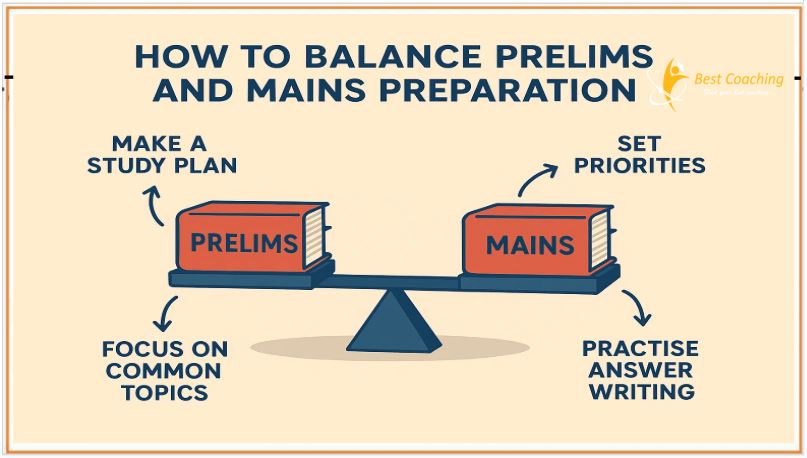



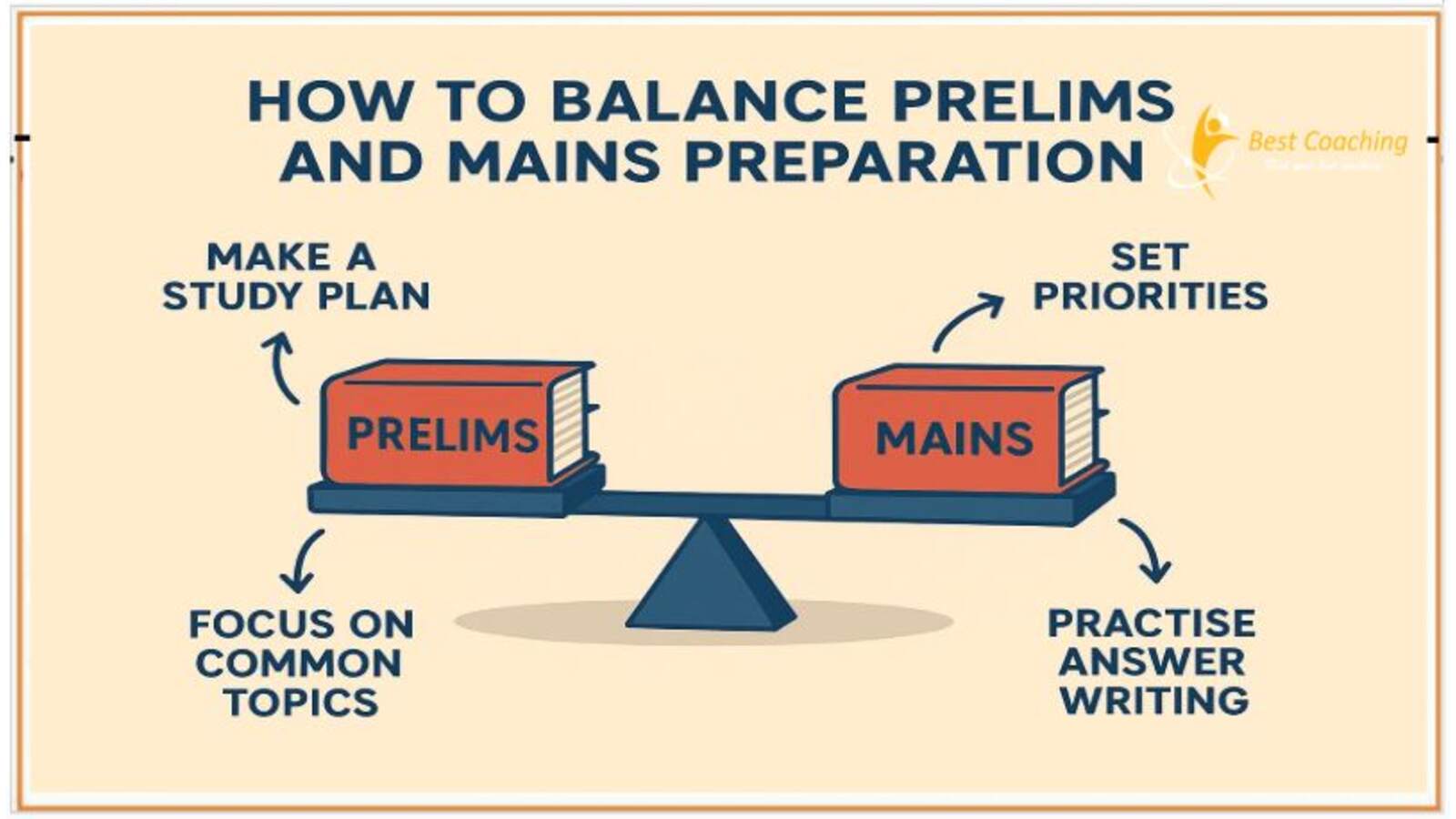
Are you one of those aspirants who are preparing for UPSC and are not able to balance Prelims and mains preparation? Then, this article is for you. In this article, we will explore how to Balance Prelims and Mains Preparation Effectively. Also, a detailed explanation about why it is important, Time allocation, and all.
The Timeline of UPSC Examinations: An Insight into Balance Prelims and Mains Preparation
Before stepping into the strategies comes the insight into the exam cycle. Usually, the Prelims are in May/June. Then comes the Mains, which are held almost 3-4 months later in September or October. Next is the interview stage (personality test) in the following year. Given this timeline, aspirants must ideally prepare for both Prelims and Mains together, at least in the earlier months.
Why is it Important to balance Prelims and Mains
A common mistake aspirants tend to make is to treat Prelims and Mains like two completely different exams. These two tests may have a different spirit in terms of questions, but the syllabus has major overlaps. Subjects: History, Polity, Geography, Economy, Environment, and Current Affairs are common grounds for both tiers.
2. Understand Mains, Practice Prelims
Though it is required for you to understand Mains, getting yourself better every day with practice becomes an act of Prelims-centered MCQ solving. This workout sharpens your speed, accuracy, and familiarity with question patterns.
Plutus IAS has daily MCQ practice along with its course of subjects for students. The source of these is NCERTs, current affairs, and many standard books, which is exactly the mix that will make up your Prelims.
This is why balancing both is essential:
The duration after Prelims is rather short for Mains preparation from scratch.
Answer writing is a skill that takes time to develop, and this is an area where the Mains Operations need a lot of expertise.
Sound knowledge about concepts is useful for solving both MCQs and descriptive questions.
It becomes easier to avoid last-minute strain and burnout.
Integrated Preparation: The Intelligent Way: Balance Prelims and Mains Preparation
The smart way is an integrated form of preparation, where you do not keep the study for Prelims and Mains separate. Let’s see how this can be done:
1. Base it on the Main Syllabus
Start your preparation with the Mains syllabus as the base. It has much more elaboration on all that is required for Prelims. So, during your study of Polity, instead of just memorizing Articles or provisions, study the subject in-depth.
Time Allocation: A Balanced Weekly Program
In the months from June to December:
You should devote 70% of your time to preparing for Mains, focusing on writing practice, GS topics, and optional subjects, and allocate the remaining 30% to Prelims practice, including MCQs, CSAT basics, and current affairs.
In the months from January to March:
Invert the effort: Now, it should be a focus on Prelims with 60% of the time.
With answer writing continued at 2–3 times a week, the Mains momentum is retained.
From now till Prelims:
Hold a full and undistracted Prelim focus-intense MCQ practice, mock tests, and revision.
Best IAS Coaching in Delhi | Top IAS Coaching in Delhi India
Prelims and on:
Thereafter, switching to Mains immediately, utilization of buffer time for intensifying answer writing, mastering general studies papers, enhancing the Essay approach, and preparing optional.
Answer Writing and Test Series
A myth that answer writing should begin only after Prelim clearance- vehemently untrue! It requires months to develop the skill set of structuring, condensing, and analyzing answers.
Plutus IAS insists on commencing answer writing early in the preparational timeline; they design their test series to build skills sequentially, starting with short 150-word answers and culminating in full-blown 250-word Mains-style answers.
There are many gains from the given test series:
Time management.Comparing the methods with the expectations of UPSC. Improving writing fluency and presentation. Preliminary Test Series and Mock Practice
While the Mains crave depth, Prelims need accuracy and speed. Meticulously disciplined mock test practice can make or break your Prelims attempt.
Plutus IAS offers a well-framed Prelims Test Series featuring:
Sectional tests for the subjects.
Full-length simulated tests.
Tackling contemporary affairs costs a lot both for Prelims and the Mains. However, one also needs to approach both of them from two angles:
For Prelims-it becomes important to focus on facts, dates, reports, schemes, and international organizations.
For Mains-focus on theoretical analyses, impact, pros and cons, and long-term implications.
Plutus IAS imparts daily as well as monthly current affairs materials in the format of crisp points for Prelims and analytical write-ups for Mains, saving both time and effort for aspirants.
Importance of optional subject preparation
So don’t just focus on your GS. Forgetting the optional might create a world of difference in your final mark. You’d better will have to start early, but best practice is to write answers along with GS preparation.
At Plutus IAS, optional subjects like PSIR, Sociology, and Geography are dealt with by subject experts with years of experience. They also offer one-on-one coaching to help aspirants fine-tune their strategy.
Conclusion:
This is all about How to Balance Prelims and Mains Preparation. Prelims and Mains, in general, are not two things to be done in tandem. They are treated more like something that calls for a smart overlapping strategy. The concepts hinge on some very strong foundations for objective as well as analytical thinking and ample pre-game preparation for answer writing and test taking.
Institutions like Plutus IAS ease this journey with an integrated test-oriented mentorship-supported ecosystem.
Related Articles: