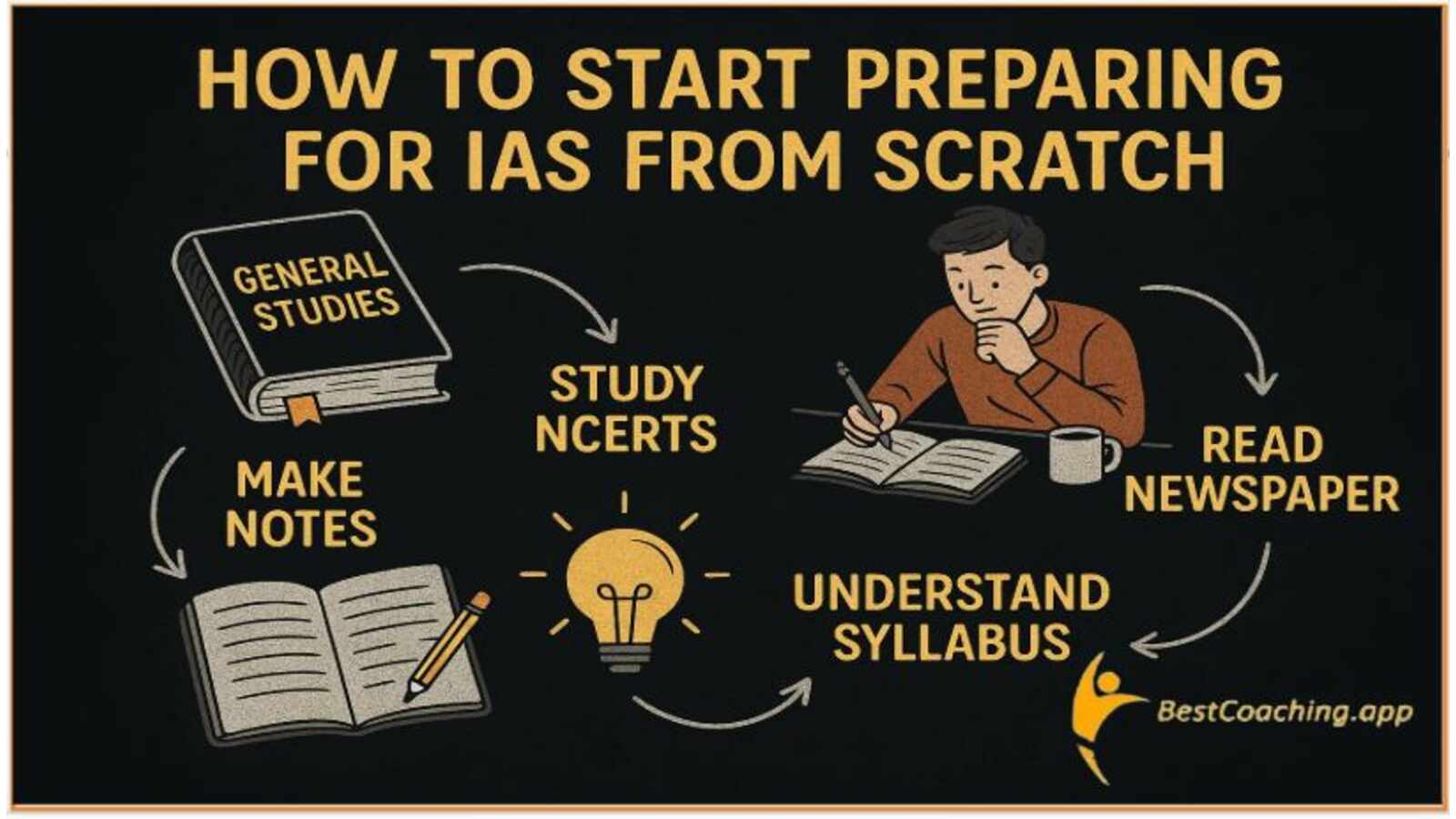



The Indian Administrative Service is one of those coveted services that are offered under the UPSC Civil Services. The IAS exam is not merely an exam; it is a journey that requires intellectual rigor, emotional strength, and strategic planning. To anyone starting from scratch, the road may look too dizzying to walk on. But with clarity in mind, consistency, and right guidance, cracking the IAS exam is nothing less than a matter of fact. In this article, we will discuss here, how should start preparing for IAS from scratch.
This guide is meant for absolute beginners who do not even know where to start, what to read, or how to schedule their time. So, shall we explore the road map, step by step?
How should I start preparing for IAS from scratch?
Let’s explore one by one.
1. Comprehend the Exam First
Before entering the bookstore or getting wrapped up into newspapers, it is essential to find out what the IAS exam is all about. Civil Services Examination, popularly called CSE, is conducted by the Union Public Service Commission (UPSC) and consists of three stages:
Prelims – It is a general knowledge and aptitude objective-type exam
Mains – It tests the candidate for conceptual understanding, analytical thinking, and expression through descriptive answers
Interview – It is a personality test that assesses the suitability of a candidate for entering the civil services
Every one of these stages is eliminative and requires a different preparation strategy. The syllabus is rather big but well enclosed. So your very first thing should be downloading the official UPSC syllabus and checking out past papers for a realistic insight into the scope.
2. A Long-Term Strategy Must Be Put in Place
Preparation for the IAS is like running a marathon, not a sprint. A minimum of 12-18 months of strenuous study is required. Hence, preparation can be divided into three phases:
Foundation (3-4 months) – focusing on NCERTs and getting a grasp of the syllabus
Core Preparation (6-9 months) – studying core books, answer writing, and current affairs
Revision & Testing (3-4 months) – mock tests, prelims/ mains revision, and actual writing
This plan is going to be your guiding hand so that you can stay organized without burning out.
3. Start With NCERT for Building a Base
NCERT books are a must for all beginners owing to their clarity, simplicity of language, and the crucial things they cover in subjects such as:
History (Class 6-12)
Geography (Class 6-12)
Polity (Class 9-12)
Economy (Class 9-12)
Science (Class 6-10)
Read slowly, taking notes and highlighting important points. Do not just finish it in a hurry. This base would make the advanced books somehow easier to digest later.
4. Stay Updated with Current Affairs
Current affairs hold significance for both Prelims and Mains. One should start the day by reading one of the two, The Hindu or The Indian Express. Concentrate on governance, international relations, environment, science & tech, and economic issues.
Additionally, monthly compilations of current affairs by coaching institutes may also be used for revision. The PIB, PRS, and All India Radio summary apps are supplemental aids.
5. Follow-up Standard Texts After NCERT
After you finish the NCERTs, one has to move on to the standard UPSC books:
Polity- Indian Polity by M. Laxmikanth
History- India’s Struggle for Independence by Bipan Chandra
Geography- Certificate Physical and Human Geography by G.C. Leong
Economy- Indian Economy by Ramesh Singh or notes by Sriram IAS
Environment– Shankar IAS book on Environment
Don’t overload yourself with multiple resources. Stick to a single one per subject and revise it a couple of times.
6. Answer Writing is Key – But Not on Day One
For newbies, writing answers from day one would be counterproductive. Focus on understanding content. Start answering only after you have read the basics and a few standard books.
Once at that stage, prior Mains questions can be practiced, or one can go for a daily program of answer writing with platforms like Plutus IAS that provide structured answer evaluation and personal feedback. Writing skills are learned by working with others, but clear and concise writing takes a lot of practice.
7. Revision is what takes one truly to preparation
Reading once is never enough. UPSC candidates are rewarded if they can recall and reproduce information. Plan for multiple rounds of revision in those last two or three months of preparation.
Prepare your condensed notes or mind maps. Keep revising. Appear for mock tests and analyze the areas where you went wrong.
8. Remember to Be Consistent Rather Than Perfect
You need not sit for 14 hours every day or cram before exams. The emphasis should be on consistency. Six to eight hours of unquestionable focus are ample when clear targets are in mind. Work on making targets for a day, week, and month. Track your progress, and modify targets if the need arises.
Wasting time on distractions or burning yourself out is not an option. Working hard toward UPSC is not the only thing; smart work counts, too.
Why Plutus IAS is the Best for Fresh Aspirants
If you are somebody aspiring from scratch who requires well-structured guidance, Plutus IAS, besides being one of the best coaching institutes of Delhi, offers excellent online classes too. Here are other reasons for it being an enticing choice for budding candidates:
- Small batch size so that full importance is given to each student
- Experienced faculty members with subject-wise expertise
- Integrated Prelims + Mains preparation
- Personal mentorship and performance tracking
- Regular Test Series and its detailed analysis
An online platform with all the flexibility for working professionals and distant Learners
The hybrid method by Plutus IAS allows the beginner to be disciplined and flexible at the same time. Their personalized approach ensures that an aspirant builds their base slowly with little content, rather than throwing them into the deep end with loads of content.
Conclusion:
Starting with IAS preparation may appear intimidating from scratch, but the thousands of aspirants before you have done it, so can you. The crux is:
– Start slow and steady
– A very strong base of knowledge is formed
– Seek assistance from some very credible institutes like Plutus IAS
– Maintain a focused mind, keep yourself engaged with timely revisions, and have confidence in the process
It is just the right pathway to go far ahead if you are a student, a working professional, or a mid-career professional frequently demanding a change. The UPSC success is just next away with utmost dedication, discipline, and right guidance.
This is all about how I should start preparing for the IAS from scratch?
Related Articles