


5000+ UPSC Selections | 1200+ IAS / IPS Officers
For Counselling Call – 8800222298
Do You want us to call? Fill the Form
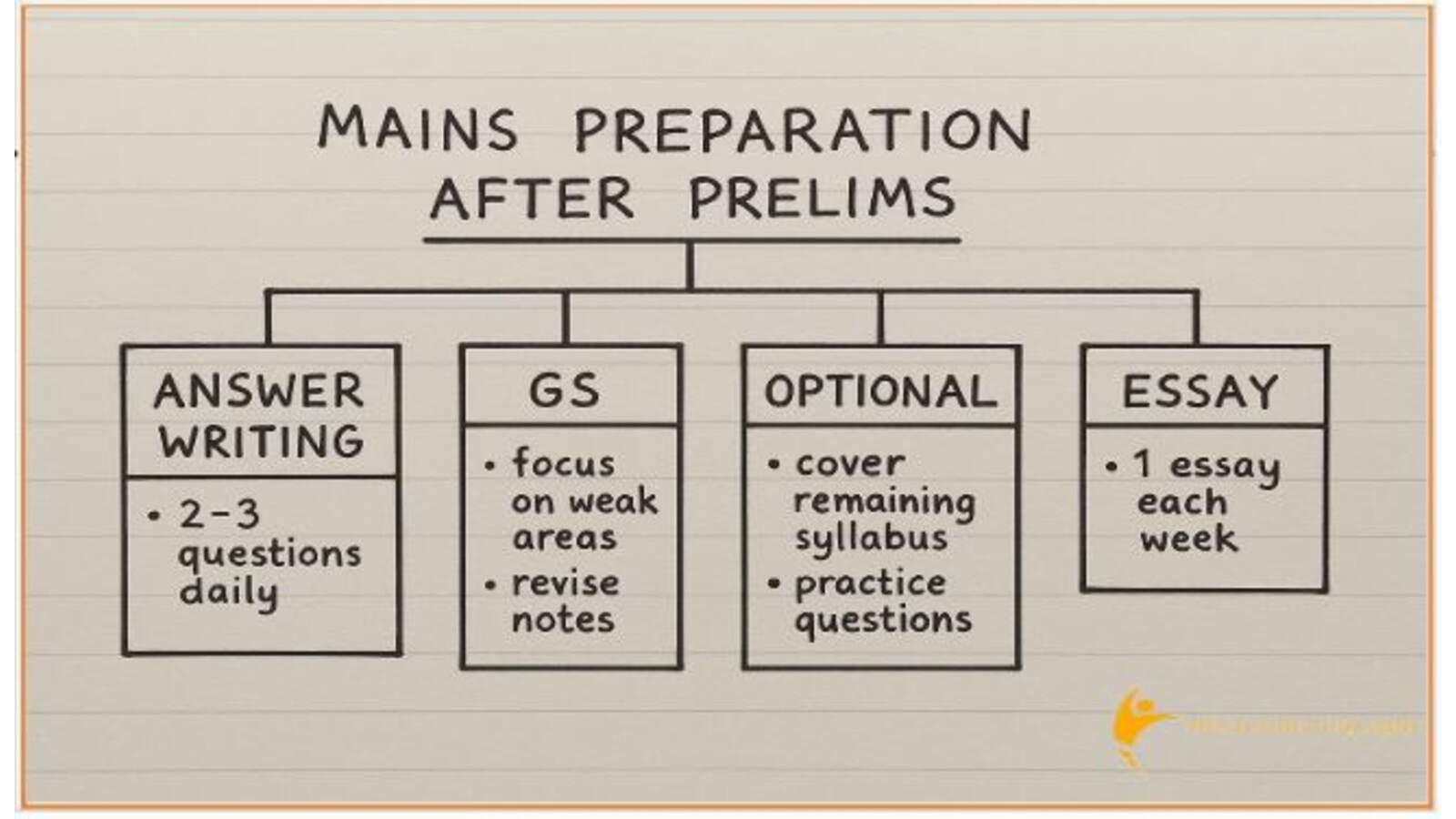
The UPSC CSE is like a three-stage journey—one must earn through the Prelims, evolve through the Mains, and be tested for personality. While passing Prelims is a significant milestone, it is the beginning of the more mundane and analytical part of the exam-the Mains one. That is where one is tested on their conceptual clarity, analytical depth, and writing skills. This article describes a definite way to go about preparing for the Mains after Prelims, along with tips on writing answers, time management, and choosing the right coaching, like Plutus IAS, one of the most trusted platforms for coaching in India. In this article, we will explore How did you plan your Mains preparation after Prelims?
Get a Bearing And Go On A Fast Gear
Prelims-to-Mains interval is generally around 100 days. As the candidate walks out of the exam hall, he should just change gears and switch full concentration to Mains. One cannot allow the uncertainty looming around Prelims results to put his momentum on hold. The majority of toppers start preparing for Mains the next day. It is very important to use the post-Prelims time window efficiently, as most probably it could change one’s final rank.
Analyze Previous Year Question Papers (PYQs)
Before diving into books and notes, allot some time for scrutinizing previous year question papers (PYQs) of each GS paper, Essay, and your Optional subject to have a crystal-clear understanding of:
- Question trend and nature
- The depth of knowledge required
- Or topics commonly repeated or twisted
Such an exercise directs your preparation towards content relevant for the exam rather than studying everything under the sun.
Lay Out a Study Plan – Weekly and Daily Targets
A realistic, time-bounded plan is very important to cover a huge Mains syllabus. Break your 100-day plan into three segments:
- First 40 days – Cover and revise key GS and Optional topics
- Next 30 days – Impart rigorous training to answer writing, giving mock tests, and value additions
- Final 30 days – For revising, essay practice, and full-length test simulations
Emphasis on Answer Writing Practice
Answer-writing practice is like polishing a jewel for mains preparation after prelims. Mains being subjective requires clarity of concepts, a rigid structure for answering, and time management, unlike prelims.
How to Write an Effective Answer?
- Answers should be strictly as per the demand of the question (Directive: Explain, Discuss, Critically Examine, etc.)
- Write bullet points and use diagrams wherever necessary
- Cite examples from relevant current affairs
- Respect the word limit and writing speed
- Practice writing answers while keeping an eye on the clock
Joining a good test series that gives adequate feedback is necessary. Here lies the difference Plutus IAS makes.
Why Plutus IAS Is Best for Mains Preparation After Prelims
If you want a structured and well-guided mechanism for Mains preparation, Plutus IAS gives you exactly that. Herein lies the potential of the institute as one of the best UPSC coaching institutes for Mains preparations after prelims.
Daily answer writing tests with expert evaluation and feedback
Mains-oriented classes for GS papers, Essay, and Ethics
Current Affairs enrichment sessions integrated with Mains syllabus
One-on-one mentoring to track the candidate’s progress and rectify mistakes
Master the Essay and Ethics Paper
Two papers, Essay and Ethics (GS Paper IV), can make the deserved difference in the final rank, but often aspirants give them a wide berth while preparing for Mains.
Practice writing essays on philosophical and contemporary topics. Ensure the essay has a strong introduction; discuss several perspectives; and provide a satisfying conclusion.
Collect real-life examples, relevant quotations, and case studies. Practice writing crisp, practicable solutions to case study questions.
Plutus IAS caters to these two subjects by way of separate modules and practice tests to ensure aspirants never lose out on these high-scoring papers.
Make Current Affairs an Integral Part of Your GS Answers
Current affairs form the very blood of Mains answers. If a static answer without any backbone of real-time data/instances/government schemes, it might stand on weak grounds. Develop the habit of linking concepts of current happenings to those in the syllabus by utilizing concepts like:
- Government reports (NITI Aayog, Economic Survey)
- Judgments by the Supreme Court
- Being current about schemes and discussing their impact
- Data released by PIB, ministries, or the UN
Plutus IAS makes this easy with its daily current affairs analysis and weekly compilations for Mains.
Conclusion
Preparation for the Mains traditionally begins with urgency, discipline, and premeditation. Do not wait for the Prelims result; rather, do your preparation in answer writing, selective reading, integration of current affairs, and practicing mocks. An equally essential factor in this exercise is choosing the right guidance.
Related Articles
Best IAS Coaching in Hyderabad